

Top 10 Hotels Where Architecture Becomes Part of the Journey
A memorable hotel is not defined by the size of its suite or the prestige of its postcode alone. The most compelling properties use architecture as a language: a way into a city, a retreat within a forest, a frame for a landscape or an introduction to a culture. In these places, the building is not simply a backdrop to the stay. It becomes part of the journey itself.
This selection brings together ten hotels whose architecture has a clear relationship with place, heritage, materials or art. The order is editorial rather than an absolute ranking. It complements our overview of the luxury hotel openings to watch in 2027 and the wider travel trends reshaping high-end hospitality.The wider picture also includes the luxury travel trends set to shape 2027.
Cover photograph: Roderich Kahn / Wikimedia Commons, licensed under Creative Commons Attribution-ShareAlike 4.0 International. The image depicts Hotel Marqués de Riscal in Elciego, one of the ten properties featured. The source file is used without alteration.
1. Aman Tokyo: Japanese calm above the city
Set high within Otemachi Tower, Aman Tokyo occupies the upper levels of a business district without relying on spectacle for its identity. The hotel has 84 suites, shaped by Japanese materials such as wood, stone and washi paper. Shoji screens, traditional stone furo baths and views towards the Imperial Palace Gardens create an atmosphere that recalls the ryokan, while embracing the vertical scale of a global capital.The brand details Aman Tokyo’s 84 suites and their Japanese design inspiration.
The achievement is the way height becomes a form of retreat. Expansive windows frame the city rather than compete with it. The experience is less about sleeping above Tokyo than finding a quiet sanctuary within its rhythm, where the contrast between urban energy and Japanese restraint becomes the defining luxury.
2. The Silo Hotel: Cape Town’s industrial landmark becomes a cultural address
At the V&A Waterfront, The Silo occupies the upper floors of a former grain complex, above Zeitz MOCAA. The wider silo transformation by Heatherwick Studio retained the industrial identity of the structure while introducing the faceted, pillowed windows that have become its signature. The hotel offers 28 suites, each with its own art-led interior and views towards Table Mountain or the harbour.The hotel presents the 28 suites at The Silo ; the wider transformation is documented by Heatherwick Studio.
The address works because it connects several scales: industrial heritage, a museum devoted to contemporary African art, the working harbour and modern hospitality. The façade is striking, but the deeper achievement is the way the hotel inhabits a piece of urban history without erasing it. Culture is not an accessory here. It is part of the setting.
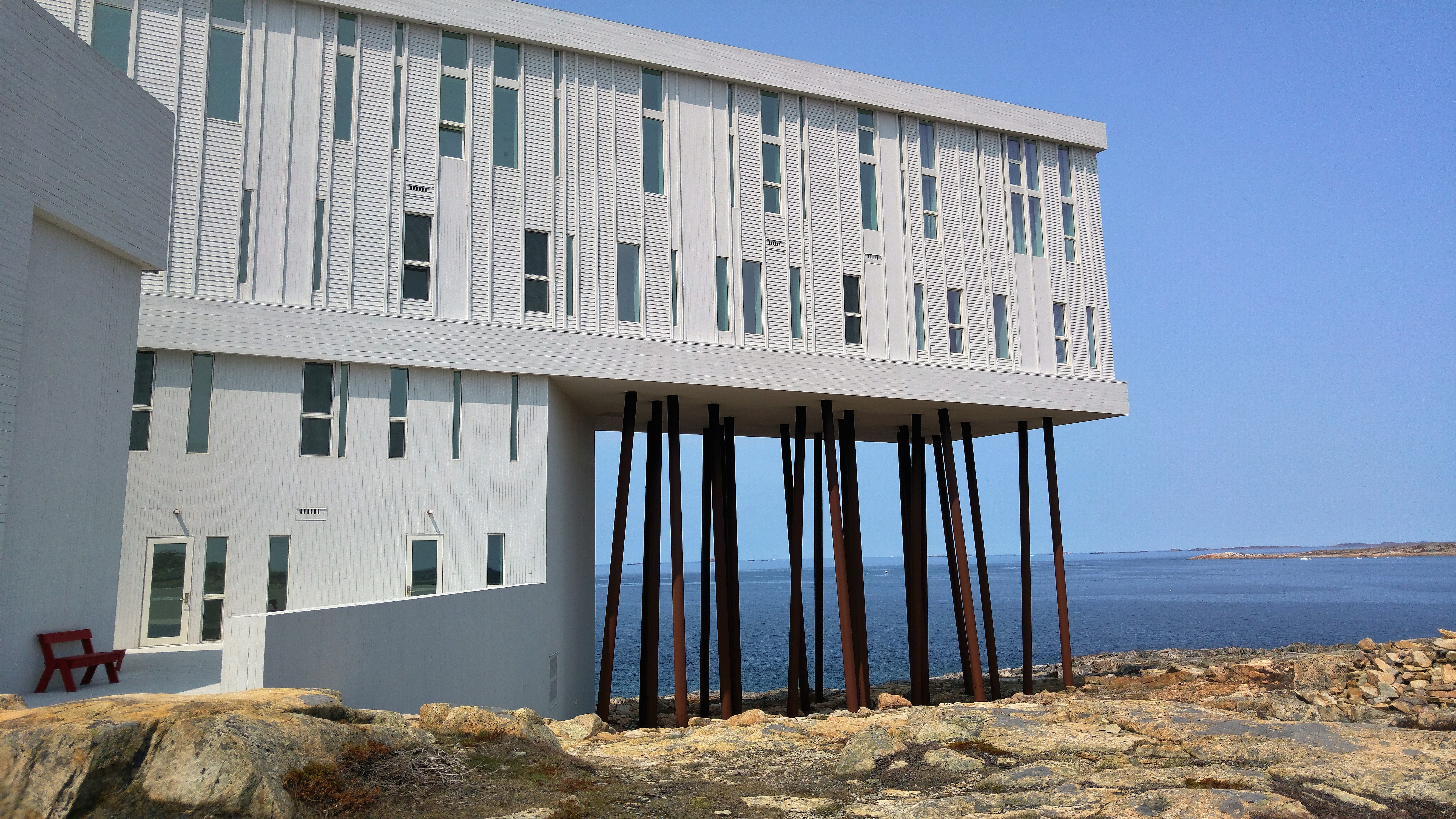
3. Fogo Island Inn: architecture that listens to the Atlantic
On Fogo Island, off the coast of Newfoundland, the inn designed by Todd Saunders draws on the language of local coastal buildings. Its X-shaped form stands on stilts inspired by traditional fishing stages, reducing its footprint on rocky ground and allowing the landscape to continue beneath the structure. The project evolved through an eight-year collaboration involving local and international makers, designers and artisans.The team explains the approach in its architectural account of the inn.
Inside, Atlantic views, materials and communal spaces continue the conversation with the island community. The building is not designed to dominate nature, but to frame weather, seasons and remoteness. It is a hotel where the destination is felt as strongly as the room, and where distance becomes an essential part of the experience. Photo credit and licence: ayphella / Wikimedia Commons , licensed under CC BY 2.0.
4. Capella Ubud: a refined tented camp in the Balinese forest
In the Keliki Valley, Capella Ubud follows the logic of an intimate camp rather than a conventional large resort. Architect Bill Bensley designed 22 one-bedroom tents and a two-bedroom lodge, each with a private pool, set among the trees. Bensley has explained that the camp was arranged around the existing forest, with no trees cut and the natural contours of the land left intact.Capella details its tents and lodge within the forest ; Bill Bensley discusses the design in his conversation about the project.
The design borrows from the spirit of early European travellers in Bali, yet the stay remains grounded in the island’s natural setting and traditions. Canvas, decks and copper baths give the accommodation a sense of narrative, while the forest remains the strongest design element. Our feature on Shore Amora Canggu explores a different side of contemporary Bali, with a more coastal, lifestyle-led approach.For a more coastal, lifestyle-led take on Bali, read our feature on Shore Amora Canggu.
5. One&Only Mandarina: villas tucked into the canopy
On Mexico’s Riviera Nayarit, One&Only Mandarina places its villas and treehouses within a tropical forest that slopes towards the Pacific. Accommodation is set at different levels, between forested cliffs and the canopy, preserving a sense of privacy and a close relationship with the terrain. The cliff villas make use of terraces, private plunge pools and open layouts, with local wood and stone that echo the volcanic landscape.The official page describes the cliff villas and their relationship with the landscape.
Luxury here is not expressed through a monumental façade. It comes from the way each volume seems to settle into the land. The resort is a sequence of individual retreats, where guests choose a view across the forest or the ocean rather than a standardised room. Architecture becomes a means of preserving privacy without disconnecting the stay from nature.
6. Rosewood Hong Kong: a hotel conceived as a vertical neighbourhood
Within the Victoria Dockside cultural district, KPF’s project brings together Rosewood Hong Kong and a large mixed-use development. The programme includes 413 hotel rooms and 506 residences, arranged as a vertical neighbourhood on the waterfront. Terraces, harbour views and public spaces give the project a wider urban role than that of a stand-alone hotel.The architecture practice outlines the Victoria Dockside project and its 413 hotel rooms.
The defining quality is the relationship between hospitality, residential life, culture and the city. The building contributes to the Kowloon skyline while helping animate the waterfront through a series of meeting places and changing perspectives. It is architecture on a metropolitan scale, designed for a stay in which the city remains present at every turn.
7. Royal Mansour Marrakech: the architecture of the Moroccan riad
At Royal Mansour, the conventional hotel room gives way to 53 independent riads arranged over three levels within an interior medina. Each residence has its own patio, decorative language and roof terrace, with zellige tilework, carved plaster, timber details and bespoke furniture. The private spaces feel closer to a traditional home than to a corridor of standardised rooms.The hotel presents its collection of 53 private riads.
Underground galleries allow staff to move discreetly around the property, preserving the privacy of guests. Architecture becomes both a showcase for Moroccan craftsmanship and a precise way of organising service. The scale is impressive, but the real distinction lies in how the building redefines the idea of a hotel room and makes privacy a design principle.
8. The Dolder Grand: heritage and modernity on the hills above Zurich
Above Zurich, The Dolder Grand offers a different conversation between eras. Opened in 1899, the hotel retains its historic Main Building, while Foster + Partners designed two new wings as part of the transformation carried out between 2004 and 2008. The project accepts the coexistence of a heritage structure and contemporary architecture instead of trying to disguise the difference.The hotel traces its architectural history and Foster + Partners transformation.
Art is central to the property’s identity. The hotel displays more than 100 works by around 90 artists. Modern volumes and historic rooms create an experience that is felt in the circulation spaces as much as in the accommodation. It is a hotel that tells part of Zurich’s story without becoming trapped in nostalgia, balancing architecture, art and panoramic views.
9. Juvet Landscape Hotel: stepping back to reveal the landscape
In Norway’s Valldal valley, Juvet Landscape Hotel takes architectural restraint to an extreme. Its seven Landscape Rooms are small volumes on stilts, with extensive glazing oriented towards the valley, forest or river. No room looks directly into another, preserving privacy while allowing the landscape to enter the interior.Juvet introduces its seven Landscape Rooms.
Dark interiors avoid competing with the views and strengthen the feeling of refuge. The architecture is not designed to be photographed first. It creates a quiet relationship with a site that changes with the season and the weather. The stay becomes an exercise in observation as much as accommodation, an invitation to slow down and look.
10. Hotel Marqués de Riscal: Frank Gehry among the vineyards
In Elciego, in Spain’s Rioja region, Hotel Marqués de Riscal carries the signature of Frank O. Gehry. Its titanium and steel ribbons, in metallic, burgundy and gold tones, appear to float above the vineyards. The property has 61 rooms, including 10 suites, across two buildings connected by an elevated walkway. Architecture, gastronomy and wine culture are brought together in a single destination.The winery details the 61 rooms and Frank Gehry’s design.
The project makes sense because it sits within the vineyards and the City of Wine, where the historic winery and hotel are in conversation. Architecture becomes a landmark in the wine landscape while remaining connected to the destination’s defining material: wine, its history, its territory and its way of welcoming visitors. It is one of the clearest examples of a building that tells the story of its surroundings without imitating them.
When the building becomes the first part of the journey
These ten hotels show that architectural luxury has no single style. It can take the form of a quiet urban sanctuary above Tokyo, an industrial landmark in Cape Town, an inn facing the Atlantic or a private riad that turns craftsmanship into a daily experience. What matters is the accuracy of the relationship between the building, the place and the way a guest inhabits it.
The next generation of hospitality will be judged on more than openings, services and facilities. It will also be measured by its ability to make a destination feel unlike anywhere else. For another perspective on the relationship between design, landscape and the pace of a stay, explore our selection of high-end wellness retreats.For another perspective on design, landscape and wellbeing, explore our selection of luxury wellness retreats.


